
a conversation with Jenny Perlin
thinking about bureaucracies, the role of the document, and tracing as artistic practice.

Back in February, I made a spontaneous trip to the James Gallery at CUNY while staying in New York. It was between the two blizzards that hit the city earlier this year, and while there were piles of dirty snow everywhere, the sun was mostly shining.
I hadn’t looked up what was on at the gallery, but what I discovered was a small retrospective dedicated to the American filmmaker and visual artist Jenny Perlin. Katherine Carl, the curator at the James Gallery, happened to be in the space when I visited. She explained to me that this was the first retrospective of Perlin’s work that’s been shown to date, and was formed in close collaboration with the artist.
Perlin is perhaps best known for her animated works, but the exhibition featured all sorts: a piece created from a pinhole camera attached to a stratospheric balloon, a series of documentary works featuring scientists and aeronauts, and a series of traced government documents that particularly caught my eye, Documents for a Report (1998-2000).
Documents for a Report was first shown in the 2000 project Carnival in the Eye of Storm, curated by Trebor Scholz. Bringing together over forty contributors for an exhibition, conference, and series of screenings, it represented both a major artistic attempt to speak to the Kosovo war and to grapple with art’s place in moments of both heightened and hidden violence.
Katherine was kind enough to put me in touch with Jenny, whom I went on to interview as part of my research for a paper on bureaucracy and infrastructure. The below is an extract from our conversation.
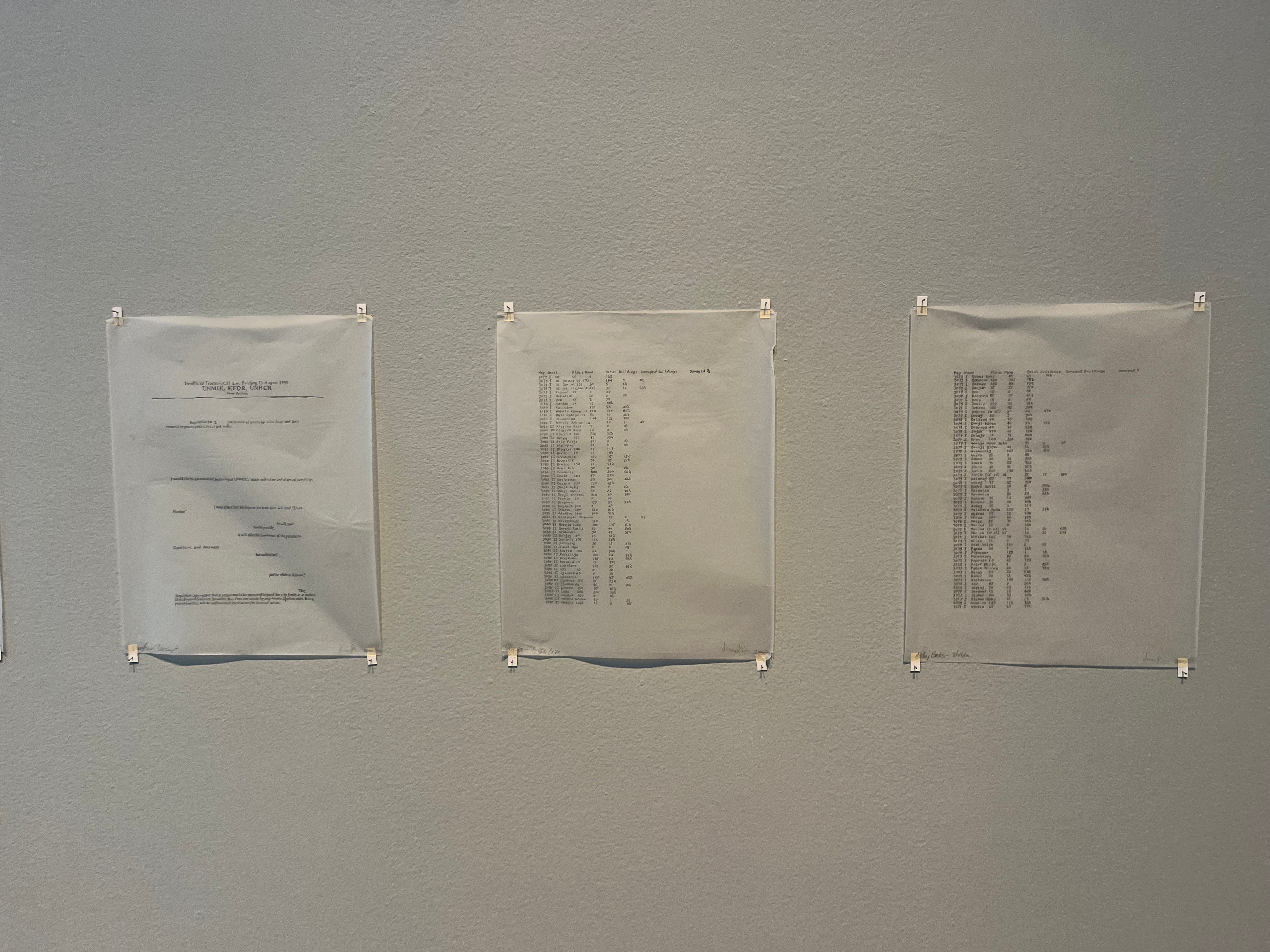
From Documents for a Report (1998-2000). Photograph my own, taken at the James Gallery at CUNY.
—
SASHA MILLS: I wanted to talk to you about Documents for a Report (1998-2000). I think that for me has been the piece I’ve thought about the most since I visited the show.
Firstly, I’m interested in how you came to that subject matter in the first place: what your entry point was into that. Equally, I’m not sure if what I saw in the gallery was the entire series, or whether there were more tracings or not.
JENNY PERLIN: That was originally a series of 90, a grid of 90 images, which, you know, if I could locate all of them, it would be really awesome. Like the later animations, copying has been a really strong part of my practice for so long.
And this was one of the earlier iterations of that attempt to get to know material through the act of copying. And how did it start? Well, I’d been following the war in former Yugoslavia for a long time. I lived in Eastern Europe in the early and mid 90s. And so already, there was a lot of migration and so forth from the former Yugoslavia to Eastern Europe. That was very compelling to me, as is generally speaking, the idea of bureaucracy and migration as a whole. I was trying to find a way to articulate the imposition of rules and structures on things that can’t be described or named.
I’ve always been very interested in the difference between a bombed home, and the writing of a note about infrastructural destruction. So many of the lists there are about towns, and houses, and things like that. In 2001, my partner and I went to Serbia and Kosovo to try to interview people about life after the NATO bombings there.
SASHA: When it comes to the copying and the tracing, you’re using these quite official documents as your source. And so part of my question was actually how you were able to access them and how you engaged with that kind of documentation, because I can only imagine the process might not have been super straightforward.
JENNY: So, I mean, this is early internet days. I was going on the United Nations Mission in Kosovo website. And in the way that I have continued to do since, my research style is quite intuitive.So I was just looking for documents that jumped out at me. I was downloading and I was printing out things from the website, and had stacks of them, and would go through them.
This was before I even started––or just at the beginning of starting––to do these text animations. From that time onwards I have tried to take a sort of aphorism or anecdote from Walter Benjamin, quite literally, where he talks about copying when he was stuck for what to do. It also has this kind of ancient, Talmudic aspect to it, I think in his case, but he would copy texts, and in that copying new ideas would form. He could kind of be in the text and outside of it at the same time.
Benjamin likened reading to flying over a landscape and copying to walking through the landscape. He talks about reading as––you get kind of an overview, you don’t necessarily feel the text, and copying allows a text to unfold under your hand. I’ve always been obsessed with that, and the kind of aspect of touch between my hand and a text or between my reading of a text and the surface of paper.
It really does have this kind of somatic, deeply present relationship with any text, and is also a kind of a way of leaping into an imaginative space. So two things happen at once with the copying, but that’s why I started doing it. And because I wanted to know, I wanted to feel deeply what, through those very boring documents, might be going on behind there.
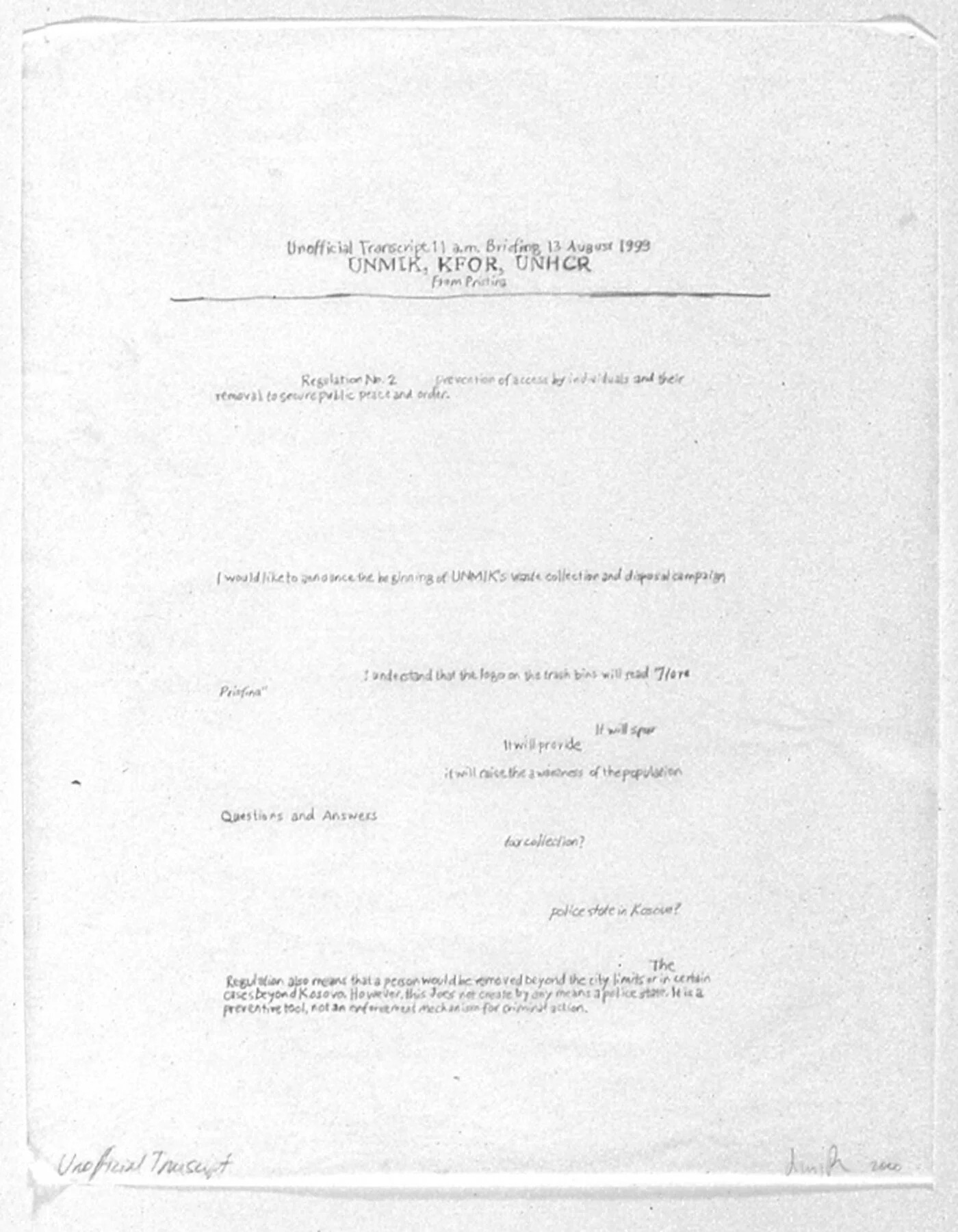
From Documents from a Report (1998-2000). Series of 50 9”x12” drawings on vellum, adapted from the United Nations Mission in Kosovo statistics and memos on civilian deaths during the war.
SASHA: I was also interested in the gaps and the things that weren’t copied and traced. Was that a case of intuition, or how did you go about that selection and that element of the making?
JENNY: I’m trying to remember specifically if it was done on the spot or if it was decided in advance. I don’t recall exactly. I don’t think I went through the text and then crossed out the things I wasn’t going to copy, for example. But clearly I had read them quite a bit and then had the tracing paper and was copying them out.
I’ve always been very interested in poetry, concrete poetry, and these kinds of processes as well. The gap on the page speaks as much as the words on the page. I wanted people––or myself––to kind of feel that I had a hand in it, right? I’m pointing to what you should be paying attention to, and that you should know that there’s a whole bunch of other stuff that I’ve removed in an editorial process.
SASHA: My reading, when I was first thinking about it, was that you go from having this structured, typeset document, to something that is a lot more embodied by nature of the fact that when you see a trace, of course it can never be a perfect tracing. That’s just not how it works.
The feeling of a hand there, I thought was interesting because it felt to me––and this is just my own reading and how I think about the politics of this sort of work, so I’d be interested in what you think––but it felt to me quite destabilising in the sense that I think that often in bureaucratic documents, there’s an attempt to speak with a totalising voice. And then it feels like in a way, you’ve introduced a body, or a singular subjectivity into that, by tracing and by removing things. I found that simple, but very clever, in the way that it sort of is playing with the role that these kinds of documents play.
I wonder how your relationship to the idea of a document has changed since then, because for me, my take would be that people are more and more used to seeing documents as an element of public discourse. How do you think that that has changed since you made this piece?
JENNY: Regarding the hand as the interface between the document and the object, while you were speaking, I was just thinking about empathy. So the work that’s trying to take place is an empathic relationship that is not judgemental of the document, nor is it trying to explain the real, lived effect. It is this something in between. And that’s been a feature of my work for a really long time.
I will also remember that at that time, I was just coming into finding a way to get text into films without it being voiceover, and without it being text on screen. This hand copying was also in that direction.
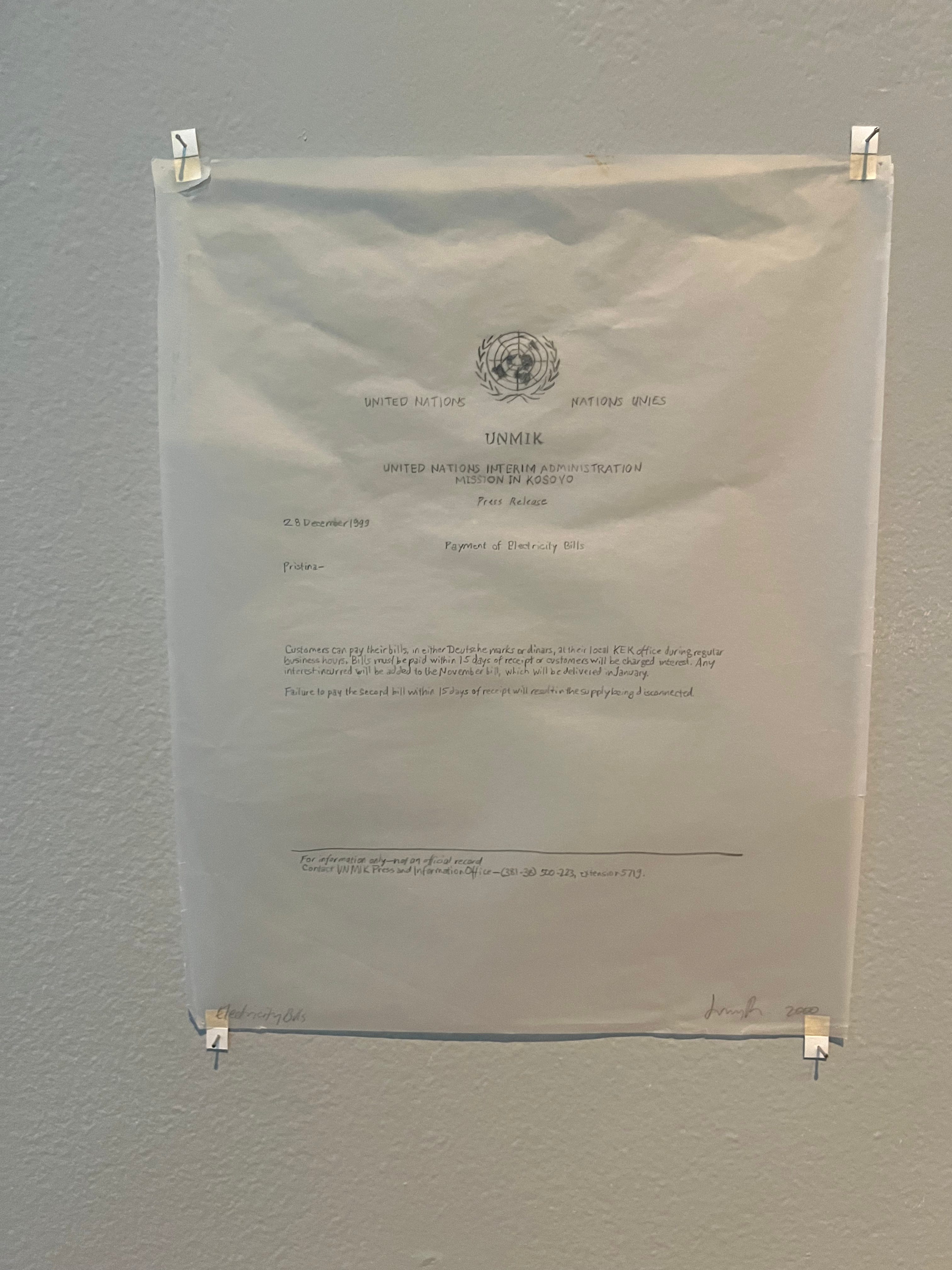
From Documents for a Report (1998-2000). Photograph my own, taken at the James Gallery.
With documents, then, they just didn’t circulate the way they do now. Either you would have to go to an archive and find them or, I mean, the internet––that time was so long ago––it was a very exciting place to find materials, but it was not easy. There’s a kind of a sense, maybe even from the Watergate era, that if you could circulate documents, they would be understood as powerful and significant and meaningful.
Whereas now––I think they are understood as that––but the moment between circulation and undermining is so instantaneous that there’s both a democratisation of the access to documents, which I think is incredible, and there’s also this kind of relentlessness about the way documents are being produced and circulated. It’s a question of trust, you know, that is part of all kinds of document revelations.
SASHA: In my broader research, I’ve been thinking a lot recently about our interaction with the archive and whether we should archive everything, and what to do with work that resists being archived.
I think for me, there’s like a sort of magic with the idea that, oh, if I go to the archives, there’s probably going to be a huge chunk that is not digitised, often because there’s not the money to do so or the people to do so. It’s an interesting reversal of that kind of feeling of potential, I guess, between what you described and perhaps what I feel now. Although, how do you feel about that change?
I was looking at your work in the context of not necessarily thinking about when things had been made in relation to one another. But I wonder how your relationship to information has changed across the course of your practice, because, of course, the binding thing with a lot of those pieces was ideas of enquiry, and scientific enquiry particularly. I’d be interested to hear you talk about your relationship to research and information, the conceptual side of that as well, and how that changed over time.
JENNY: I love thinking about what you just said, about discovering something that has not been ingested in an archive. I do see that as playing into the deep renewal of interest on the part of my students, for example, in analogue technologies and in-person meetings, DIY publications, and things like that.
I was not a big early internet adopter. But the access was really exciting. I think there was a sense at that time of a global research opportunity that would allow people to be in one place and extend themselves outwards and share and exchange.
Regarding my work and information and enquiry, how that’s changed. I mean, I often think of what I do–– even though I don’t have any relationship to fishing––I always think there’s a couple of metaphors. I throw a giant net into the sea and I bring back all kinds of crap. Then I start looking through it, and see what stands out. That sense of digging or wandering is what drives my research, at least in the initial phases, which I don’t think is rare in any way.
I think maybe what changed over that period, if I’m thinking about the exhibition, is it is more overt. I have always gone out and talked to people and brought their stories back into the work, but I think now, there is more in the work of being out in the world and talking to people, and considering that as representative of bureaucracy, or infrastructure in the same way that archival documents are. It’s almost like creating one’s own archival materials.
–
You can learn more about Jenny’s work on her website or over on her own Substack, The Beyond Place.